Mount Olympus is the highest mountain in Greece, rising to 2,917 meters (9,570 feet) and located near the border between Thessaly and Macedonia. In ancient Greek mythology, it was believed to be the home of the twelve Olympian gods, ruling from its mist-shrouded peak. Today, Olympus is part of a national park established in 1938—the first in Greece—and is recognized as a UNESCO Biosphere Reserve due to its rich biodiversity, including hundreds of plant species and endemic wildlife. An interesting detail is that the summit, known as Mytikas, was only first officially climbed in 1913, which is relatively late given its mythological significance. The mountain holds both cultural and ecological importance, drawing hikers, climbers, and scholars interested in everything from mythology to alpine botany.

During our summer 2025 road trip through northern Greece, we ended up on Mount Olympus’s southern slopes for a weeklong music festival near the village of Karya. Since we were there, we couldn’t leave without completing a hike/pilgrimage to the summit.
It would be my third ascent of Greece’s highest peak, and I was eager to try a new route. My first idea was a long (3–4 day) camping round trip from Karya, but the locals told us there wasn’t a single spring along the entire way. Okay—maybe one for the winter.
Next, we considered starting from Vrysopoules in the southwest, but it turned out that Sophie, being a foreign citizen, would need a special permit to pass through the military camp there. Complicated.
With no better options, we finally went for the classic approach: starting from Litochoro, at the eastern foot of Mount Olympus. In this post, I’ll share my trip report and some photos from the hike, along with all the practical info and tips you might need to do it yourself.
Contents
Affiliation disclosure: By purchasing goods or services via the links contained in this post, I may be earning a small commission from the seller's profit, without you being charged any extra penny. You will be thus greatly helping me to maintain and keep enriching this website. Thanks!
How to Get to Litochoro
If you don’t have a car, Litochoro is easily reachable by public transport. From Thessaloniki (1 hour) or Athens (5–6 hours), take an intercity bus to Katerini, then switch to a local bus to Litochoro. Several buses run daily, and the ride takes about 30–40 minutes. In summer, you can also take a bus to Prionia—the common starting point for hikes to Mount Olympus—if you don’t want to start all the way from Litochoro.
If you prefer, you can also arrange a comfortable private transfer from anywhere in the country. If you’re planning to drive yourself, you can look for the best car rental deals here.
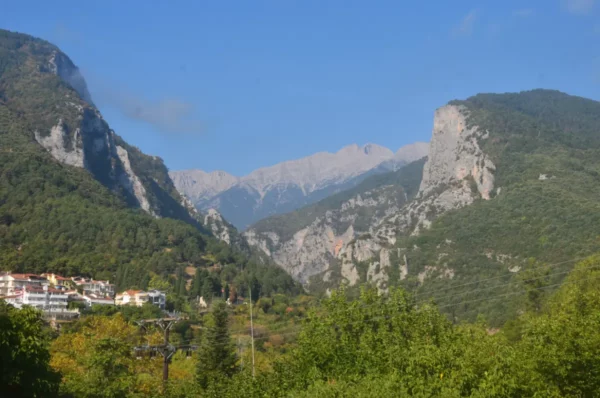
Where to Stay in Litochoro
Here are some recommended places to stay if you plan to spend a night in Litochoro before or after your hike:
- Riverbed Traditional Guest House
A cozy, stone-built guesthouse with traditional architecture and a peaceful setting. Ideal for hikers and couples looking for a quiet stay near the Enipeas Gorge. - Meydani Suites
Centrally located with modern rooms and minimalist decor. A good choice for visitors who want to be within walking distance of restaurants, cafes, and the main square. - Olympian Panorama
Set on the hills above town, this property offers panoramic views of Mount Olympus and the sea. Great for travelers seeking tranquility and scenic surroundings.
Explore more accommodation options:
Stay22 is a handy tool that lets you search for and compare stays and experiences across multiple platforms on the same neat, interactive map. Hover over the listings to see the details. Click on the top-right settings icon to adjust your preferences; switch between hotels, experiences, or restaurants; and activate clever map overlays displaying information like transit lines or concentrations of sights. Click on the Show List button for the listings to appear in a list format. Booking via this map, I will be earning a small cut of the platform's profit without you being charged any extra penny. You will be thus greatly helping me to maintain and keep enriching this website. Thanks!
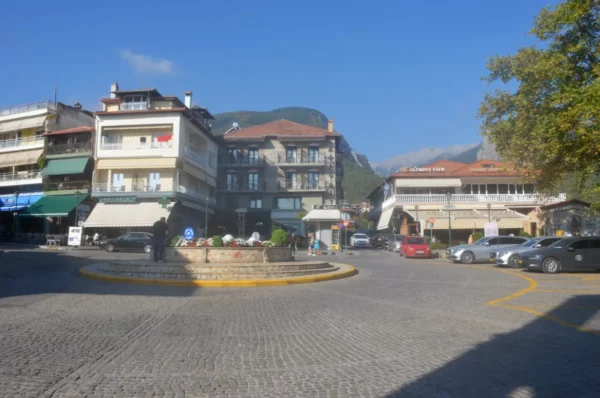
Do You Need a Guide to Climb Mount Olympus?
Hiring a guide isn’t mandatory for climbing Mount Olympus—and in most cases, you won’t need one. The trail is easy to follow and well-marked all the way up to the final push to Mytikas. In summer, you’ll likely be sharing the route with hundreds of other hikers, making it all but impossible to get lost.
You might consider hiring a guide only if you’re not comfortable with the exposed scrambling and easy climbing required for the final ascent to Mytikas. With moderate mountain experience, you’ll be fine. But if you lack that, be aware that it can feel intimidating. In that case, a guide can help you navigate the tricky sections safely.
If you decide to join a guided tour, you can find multiple tours online, including on major platforms like GetYourGuide or Viator. I’d personally recommend Explore-Share. They offer a wide range of Mount Olympus activities, including a beginner-friendly day hike through Enipeas Gorge, a semi-guided Mytikas summit climb for hikers who arrange their own approach to the refuge, standard two-day and three-day guided ascents, a six-day hut-to-hut trek, and a demanding winter ascent for experienced alpinists. Whatever your fitness level, experience, or available time, you should be able to find an option that suits you.
Hiking from Litochoro to Mytikas
The standard route to the summit of Mount Olympus begins at Prionia (location), 18 km upslope from Litochoro. Alternatively, you can start directly from Litochoro and hike through the Enipeas Gorge—a stunning ravine with natural pools, small waterfalls, and caves. This approach adds around 12 km, 700 meters of elevation gain, and roughly 5 extra hours to the trip. It’s the route I took on both my previous ascents. This time, though, we went for the shorter option from Prionia.
Whether you hike or drive, shortly before Prionia, you can visit the ruins of the historic Monastery of Saint Dionysios of Olympus (location). Founded in 1542, it played a significant religious and cultural role during the Ottoman era and served as a center of resistance during World War II.
We skipped the monastery and drove straight to Prionia. It was a September weekend, and cars had overfilled the designated parking space and spilled down along the roadside for several hundred meters. We added ours to the tail, boiled some noodles on the spot for lunch, and continued on foot.
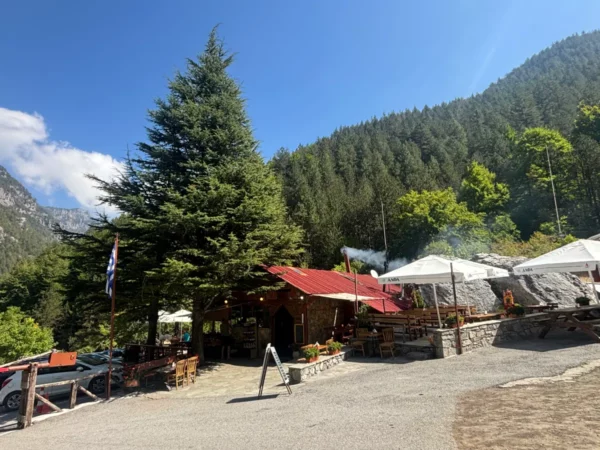
Next to the parking lot, there’s a tavern and a spring. It’s a good idea to fill your bottles here, as you might not come across more water until the refuge—especially in summer. We actually carried all the water we needed for the entire trip, since a 1.5-liter bottle at the refuge costs €2.50.
Besides the standard trail, there’s an alternative approach—the Gomarostalos route—starting from Prionia and leading to the summit of Mount Olympus via the Plateau of the Muses. Although slightly shorter, it’s considerably more technical and requires climbing gear. If you’re properly equipped and experienced, you could do a loop combining both trails. You can overnight at either the Kakalos or Apostolidis refuge on the Plateau. Since we weren’t prepared, we stuck to an out-and-back hike along the classic route.
The standard route—part of the E4 long-distance trail stretching from Cabo de São Vicente in Portugal to Sitia on Crete—reaches Mytikas in about 9 km with 1,800 meters of elevation gain from Prionia. While a strong hiker could manage it in a long day, most choose to overnight at the Spilios Agapitos refuge.
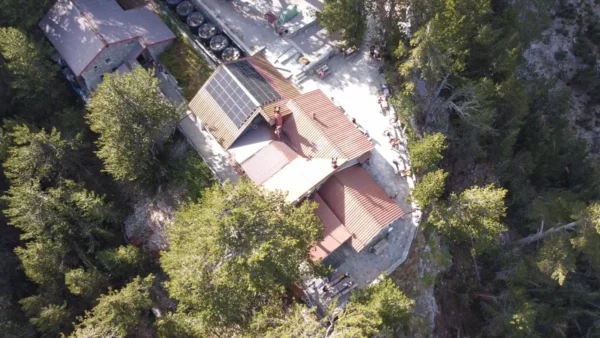
A night in a refuge dorm costs €18. If you have your own tent, you can camp on the refuge grounds for €8—but frankly, if you’re carrying a tent, you might as well camp for free anywhere else. Dorm sleepers are expected to bring their own sleeping bag or sheets. Be sure to pack a torch and plastic bags for your rubbish—there are no bins, and lights are turned off at night. The refuge also serves good meals at fair prices. There are no showers or running drinking water on the spot. As I already mentioned, they sell bottled water for €2.5. Especially if you’re going on a weekend, it’s best to book ahead via their site or by calling (+30) 23520 81800.
Back at Prionia, we left the parking lot and hit the trail just after noon. Not far in, we crossed a cute wooden bridge overlooking the Enipeas Waterfall. There’s a pool at its base that’s perfect for a quick dip if you’re hot enough to brave the cold.
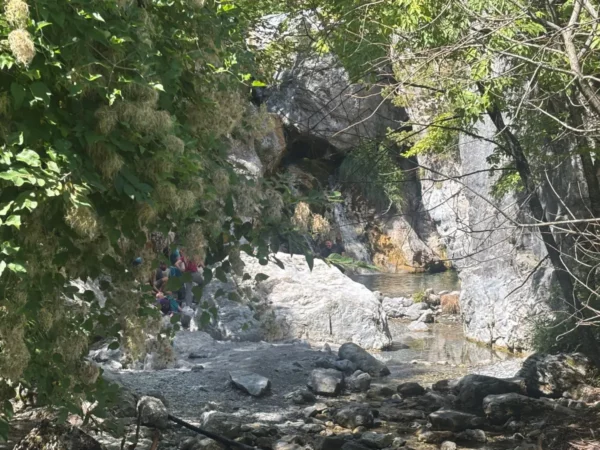
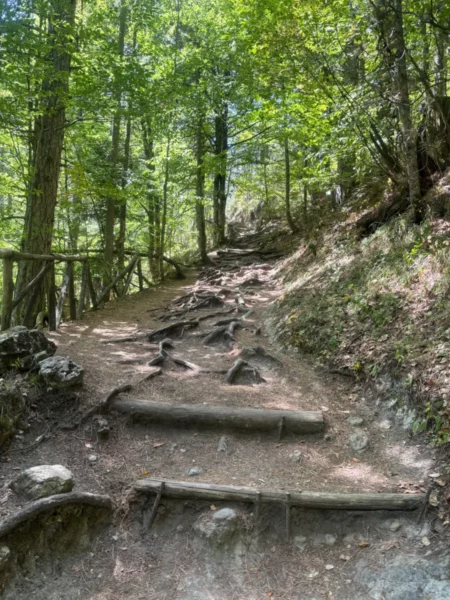
The trail climbs steadily through dense forest, but it’s mercifully shaded almost the entire way. Mostly tall beeches and firs, with the occasional pine leaning dramatically over the path. Ferns crowd the understory, and here and there, bursts of wildflowers still hang on from late summer.
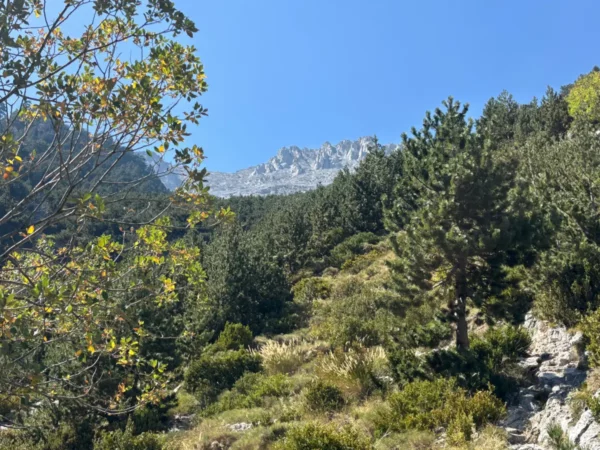
As we gained altitude, the canopy began to thin, and long gaps opened between the trunks. The views started reaching farther—first the forested folds of the mountain itself, and eventually, the pale shimmer of the Aegean far off to the east. That moment when sea and summit come into the same frame never gets old.
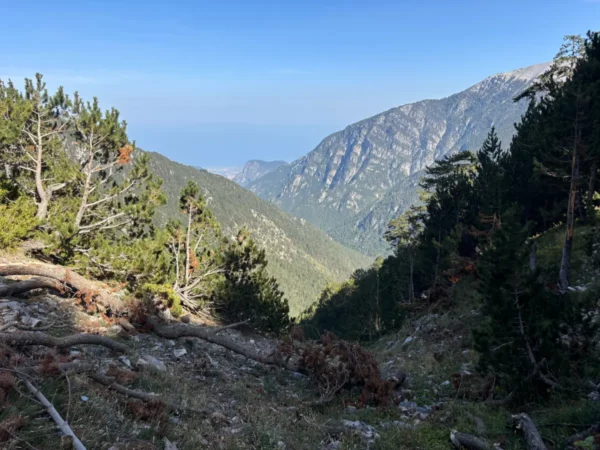
There are a couple of rest kiosks along the way—simple wooden shelters with benches where you can drop your pack and cool off for a bit. The trail was fairly busy, with a steady flow of hikers in both directions to have a chat with now and then.
We reached the Spilios Agapitos refuge in about three hours, including a few breaks. It sits just above the treeline, nestled into the slope, and marks the real transition from forest to alpine.
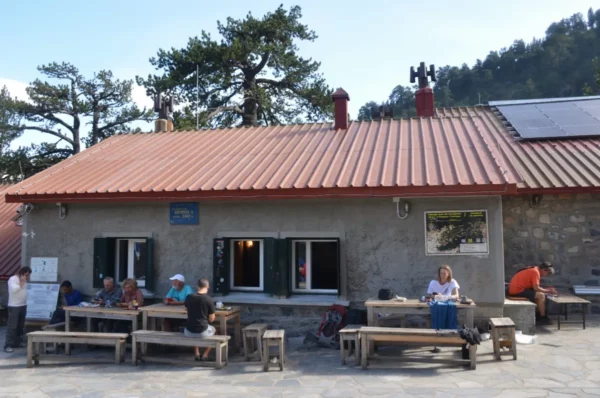
It was already packed. I don’t think there was a single bed left by evening. We spent the rest of the afternoon soaking in the view and the last of the sunlight. And after a comfortingly hot meal, we hit the hay.
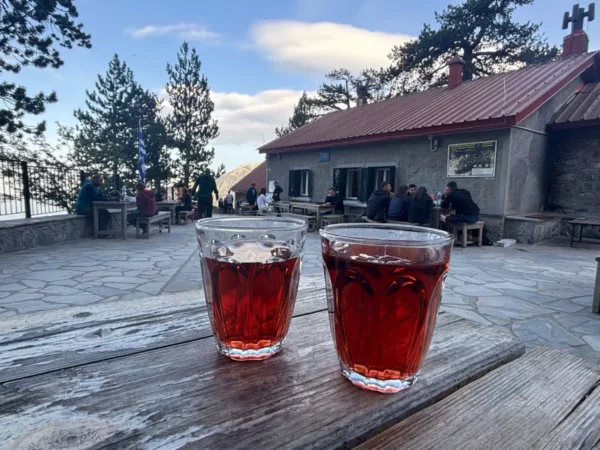
We were up again long before the faintest hint of daybreak colored the marine horizon far below. Only the stars drew a line between the black sky and the blacker mountain. After a quick coffee and some breakfast, we packed what we needed, left the rest to collect on our way down, and started working our way up the steep slope.
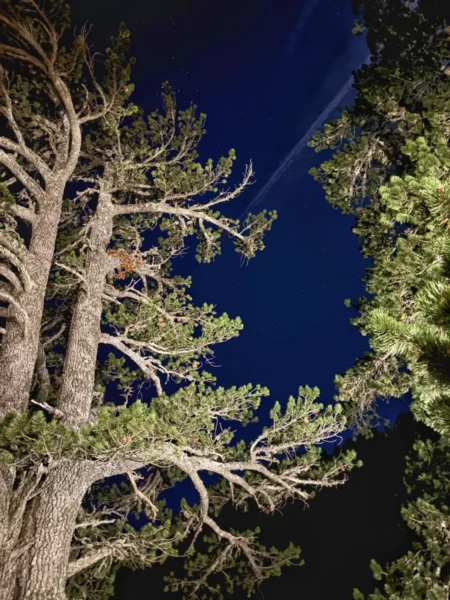
The climb out of the refuge felt different. We rose while the world was still locked in blue‑black quiet, the first stirrings of dawn far down at the horizon. As we ascended, the sky lightened slowly, and then the sun burst forth: a pale orb lifting from the Aegean, flooding the sacred slopes of Mount Olympus with gold. The rocky ridges glowed, shadows retreated, and the moment the mountain bathed in early light was absolutely beautiful.
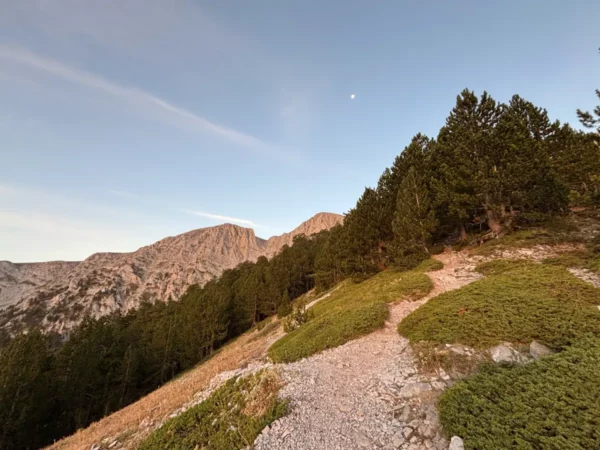
The ascent was relentless. After the last trees, the trail emerged into the raw, alpine world—bare rock, brittle scree, and open sky. Broad slabs of grey limestone sloped upward in rough, uneven waves, the terrain stripped down to its harsh essentials. Peaks and ridgelines closed in around us, jagged and solemn, like the worn bones of the mountain laid bare. The footing was loose in places, and every step demanded attention. With the forest behind us, there was nothing now but rock, wind, and light.
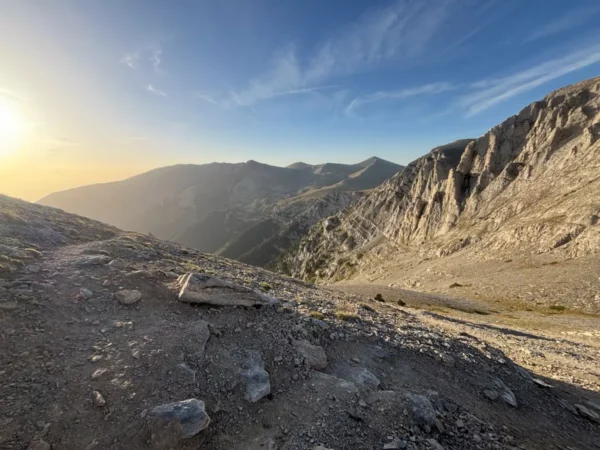
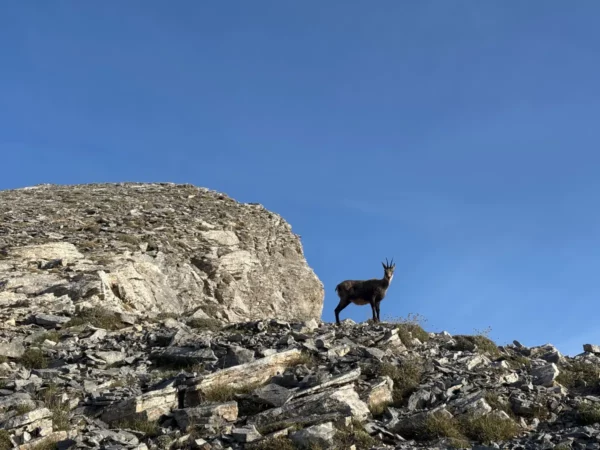
Looking back, the sea lay faint but definite, a shimmering line on the horizon beyond the green folds of lower slopes. Ahead, the higher ridges steeled themselves in rough rock, gullies carved by ancient glaciers or meltwaters, the trail a zigzag through stone and scree. The air was thinner; we paused more often now, breaths deep and deliberate. A lone wild goat attended our toilsome advance with a mix of caution and derision.
We made it to Skala: the final vantage before the summit push. Mytikas, a jagged crown of stone rising above sheer drops and crumbling gullies, loomed across the chasm. In that stark terrain, reaching this notch felt like entering the gods’ realm itself.
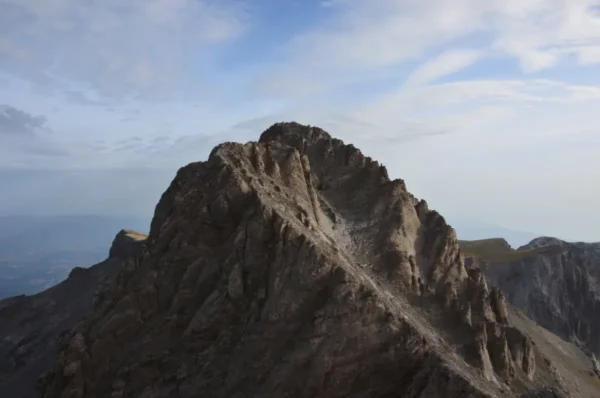
Up to that point, it’s just hiking—tiring, sure, but straightforward and safe. From there on, the real fun begins. The traverse to Mytikas via Kakoskala looks intimidating from across the gap, but it’s not as bad as it seems. It involves basic scrambling, no ropes needed. That said, there are a few exposed sections where a slip could be fatal. If you’re not used to that kind of terrain, it can feel sketchy. Just stay calm, breathe, and avoid looking down.
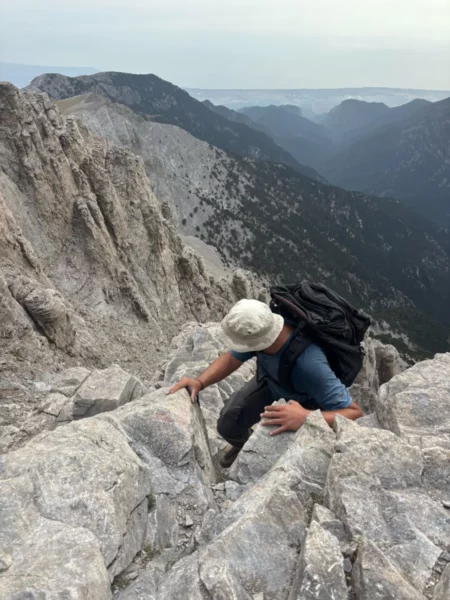
If it’s not your thing, no shame—Skolio is a solid alternative. It’s the second-highest peak on Olympus and an easy walk west from Skala.
We soon reached Mytikas. Exceptionally lucky with the weather—clear skies, barely a breeze—we stayed for well over an hour, taking in the magnificent view, eating our packed lunch, snapping photos, flying our drone, and trading stories with the other hikers we shared this rare moment with.
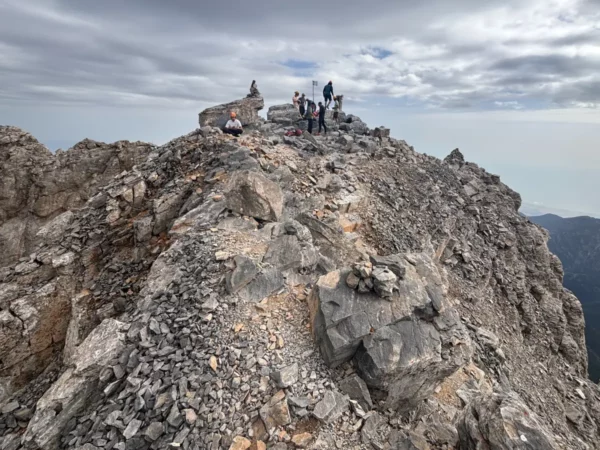
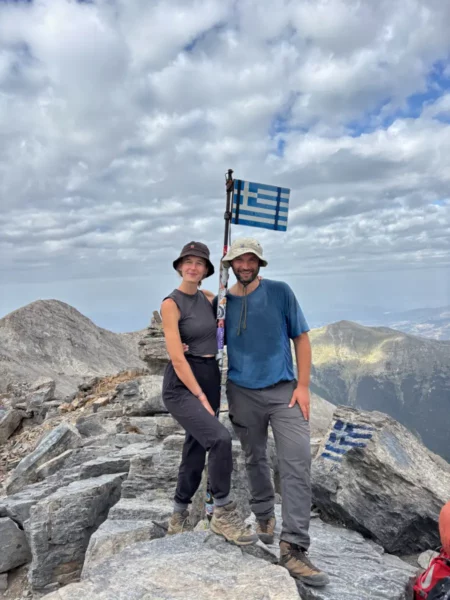
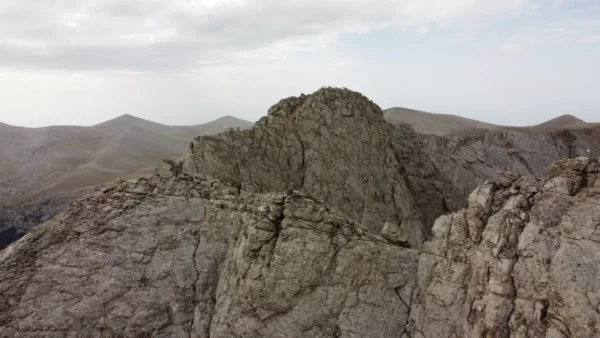
We followed the same long route back and reached Prionia by late afternoon. After a hearty meal at the tavern, we got in the car and drove the four hours straight back home to Evia.
Videos
Photos
View (and feel free to use) all my photographs from Mount Olympus in higher resolution.
⇧