Puerto Nariño is a small riverside town in Colombia’s Amazonas Department, about 75 km upstream from Leticia along the Amazon River. Founded in 1961 and later developed as a planned settlement for Indigenous communities, it’s widely known for its strict ban on motor vehicles—movement happens on foot, by canoe, or by small river boats.
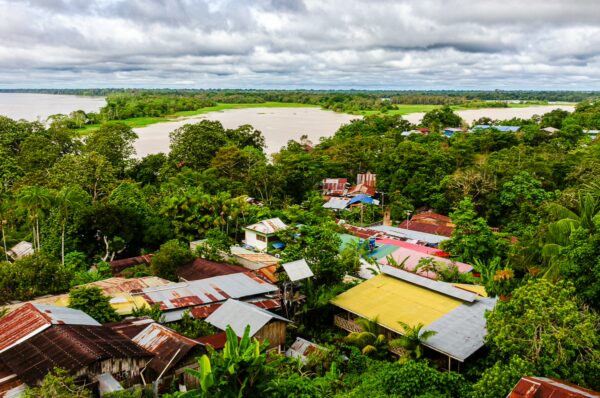
The area is home mainly to Ticuna and Yagua Indigenous people, whose cultures still shape daily life in the region, from fishing practices to local handicrafts and community governance. Over the years, Puerto Nariño has gained a reputation as one of the Amazon’s cleaner and more organized river towns, with wooden walkways, stilt houses, and viewpoints overlooking the vast brown sweep of the Amazon and the nearby Loretoyacu River. For travelers based in Leticia, it’s the easiest way to experience a quieter Amazonian settlement without venturing deep into the jungle.
We visited Puerto Nariño independently on the final day of our five-day stay in Leticia, after already spending two days on a jungle tour to Gamboa Reserve. With an evening flight back to Medellín, we caught the first morning ferry upriver and returned on the penultimate one in the afternoon. The timing worked well and left us several hours to explore the village and its surroundings. In hindsight, staying overnight would allow more time to see nearby lakes and communities, but for a place this small, a day trip is still enough to get a solid sense of it. Here’s how the trip went and the practical details you need to replicate it.
Affiliation disclosure: By purchasing goods or services via the links contained in this post, I may be earning a small commission from the seller's profit, without you being charged any extra penny. You will be thus greatly helping me to maintain and keep enriching this website. Thanks!
The Boat from Leticia to Puerto Nariño
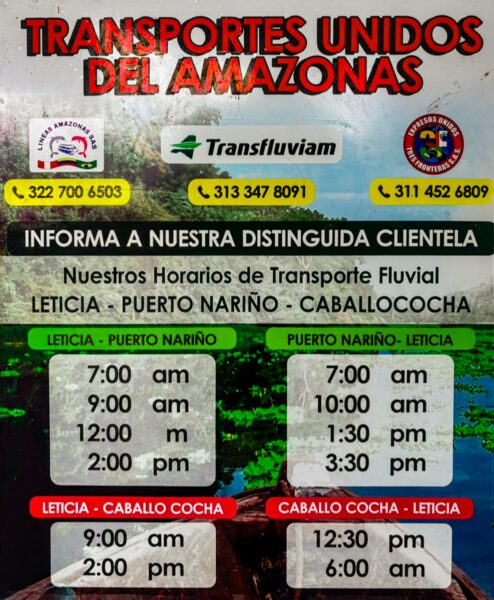
During our visit, there were four public boats per day in each direction between Leticia and Puerto Nariño. From Leticia, departures were at 7:00 am, 9:00 am, 12:00 pm, and 2:00 pm. The return boats from Puerto Nariño left at 7:00 am, 10:00 am, 1:30 pm, and 3:30 pm. The trip takes about 2.5 hours.
Boats depart from Leticia’s river terminal (📍map)—basically a platform of stitched-together planks resting on thick wooden trunks. Tickets are sold at one of two small offices across the road from the dock. At the time of our visit, the fare was 45,000 COP per person. We bought ours the previous day and were told to arrive at least an hour early. Heaven knows why… Boarding didn’t begin until about ten minutes before departure, and the boat eventually left around ten minutes late.
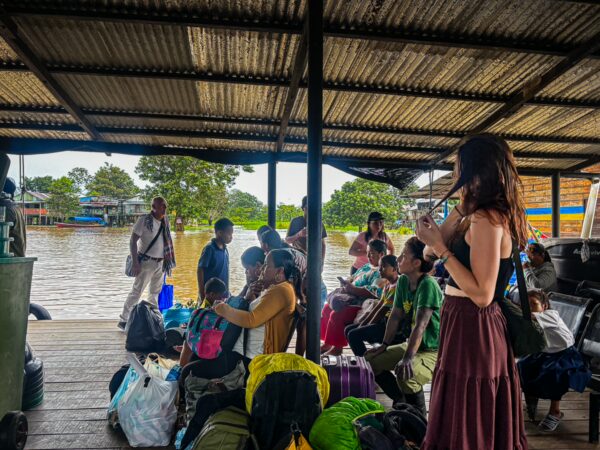
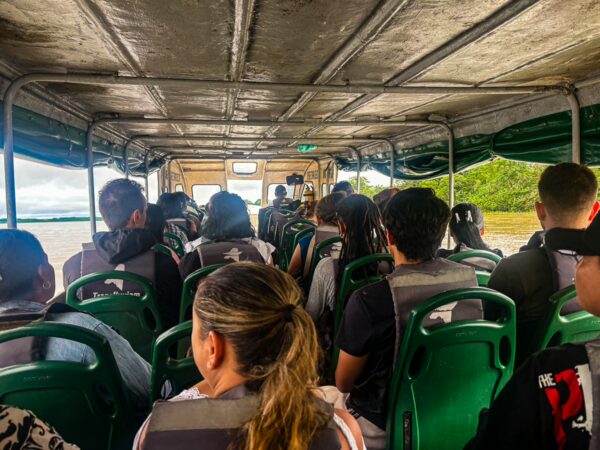
Before setting off, the crew moved a few passengers from one side of the boat to the other to balance the load. An interesting routine. Once underway, the ride turned into one of the highlights of the day. The long, narrow speedboat skimmed quickly over the wide brown surface of the Amazon, with dense rainforest walls rising on both sides. Along the way, the boat made several stops: tourists getting off at isolated jungle lodges, and locals hopping out at small riverside communities, sometimes stepping directly from the boat into the mud along the banks. Despite the late departure, we reached Puerto Nariño exactly on schedule, after roughly two and a half hours on the river.
A Walk around Puerto Nariño
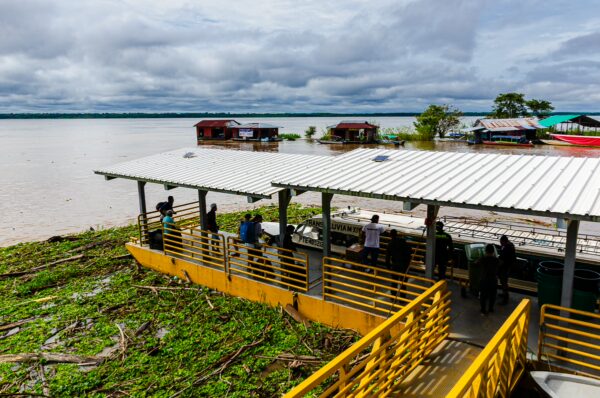
After disembarking, the first stop was a small desk near the dock where visitors were required to pay a 30,000 COP environmental entrance fee. Right next to it stood a guide with apparently privileged access to arriving passengers who tried to sell us a boat excursion to nearby Indigenous communities. It sounded interesting, but we only had a few hours in town. From there, a long wooden pier on stilts led inland into town.
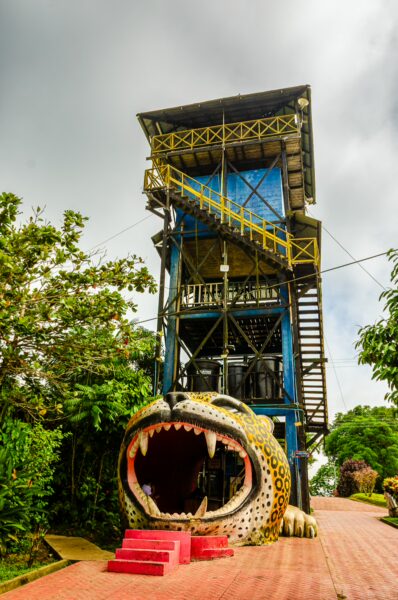
Our first stop was the Mirador Turístico (📍map), the town’s watchtower. We walked through the gate formed as a large sculpted jaguar mouth. To go up, we had to show the ticket from the environmental tax checkpoint. A spiral staircase climbs around the structure to the top platform. From above, you get a clear view over the stilted houses of Puerto Nariño, the surrounding rainforest canopy, and the wide brown stretch of the Amazon River.
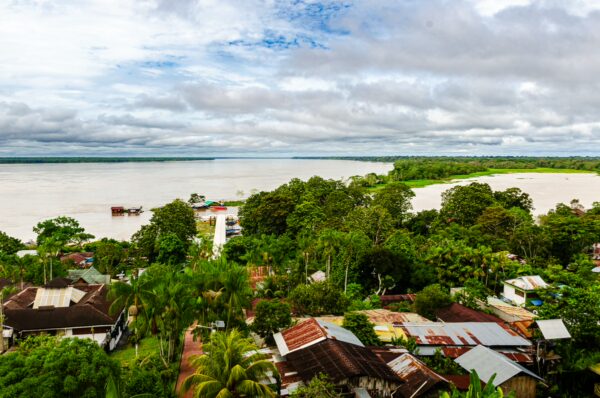
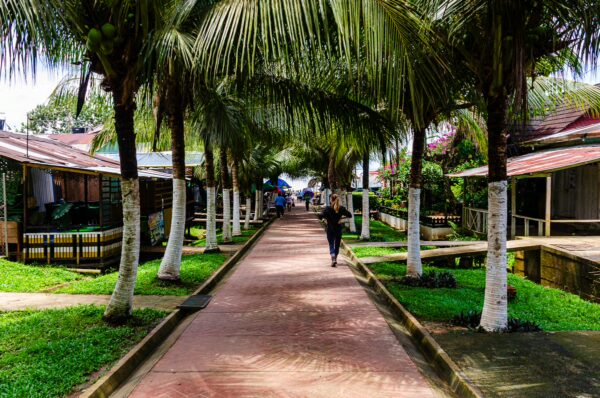
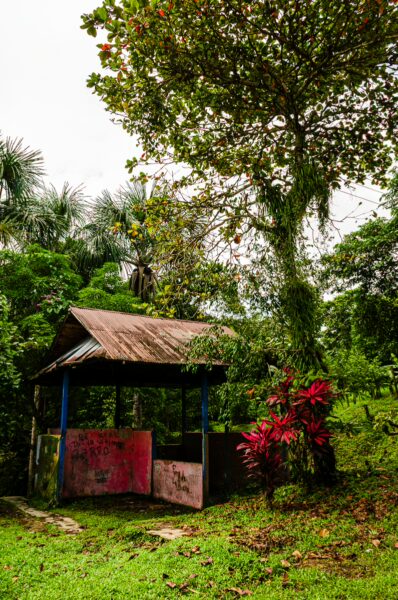
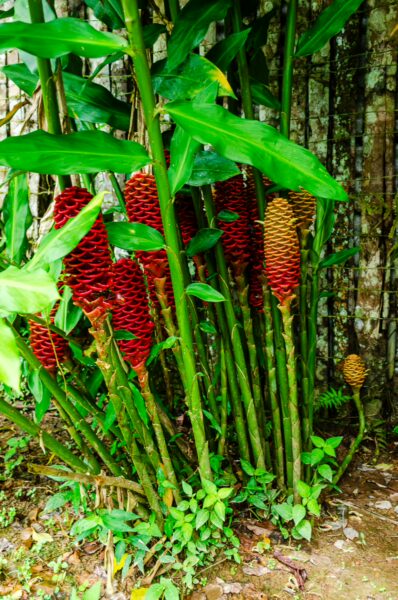
We then followed a set of muddy, sloping paths that led slightly uphill away from the riverbank. The ground was slippery after rain, and the trail ran between dense vegetation with birds constantly calling from the trees. Uniformed schoolchildren were heading home, gamboling and laughing, along the same path. When the mud got too deep, we retraced our steps toward the town center, where small shops and colorful statues of local animals line the walkways.
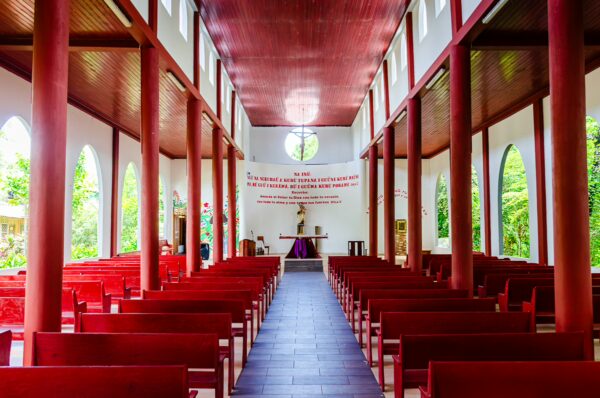
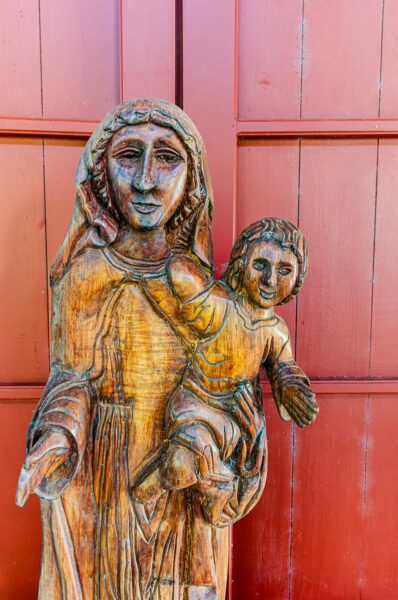
One of the most prominent buildings is a small, modest church with largely open walls. Inside, an inscription appears in an Indigenous language—likely Ticuna, the language spoken by many Indigenous people in this part of the Amazon. I didn’t bother trying to translate it—boring Christian stuff, surely. A wooden sculpture of Mary holding baby Jesus was more interesting. They both smiled, somewhat unusually for the typically stern tone of Christian imagery.
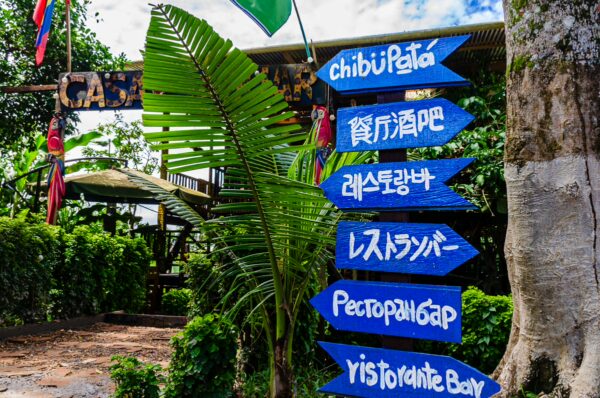
We stopped for a drink at Casa Jaguar (📍map), ordering coffee and a glass of copoazú juice—a local Amazonian fruit drink that, to us at least, had a strangely fish-like aftertaste. Two stray dogs spent most of our visit fighting under the table while the rest of the place carried on normally. The terrace faces one of the main village roads, which makes it a good spot for people-watching. At one point, a trash-collecting tractor, the only motor vehicle we saw anywhere in town, slowly passed by honking to signal residents to bring out their garbage.
A little further on, we walked into a souvenir shop (📍map). It was run by four local craftsmen and filled with paintings, textiles, carved wooden sculptures, dreamcatchers… a great assortment of color and imagination.
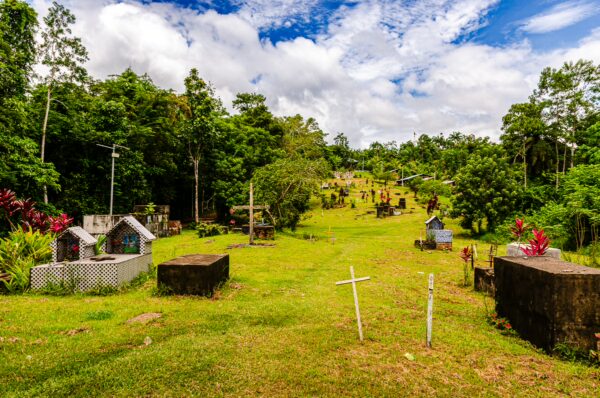
Then we followed a path crossing a small bridge leading west outside the core of town. The route passes neat wooden houses surrounded by thick vegetation and eventually reaches the local cemetery. After that, we headed back toward the riverfront.
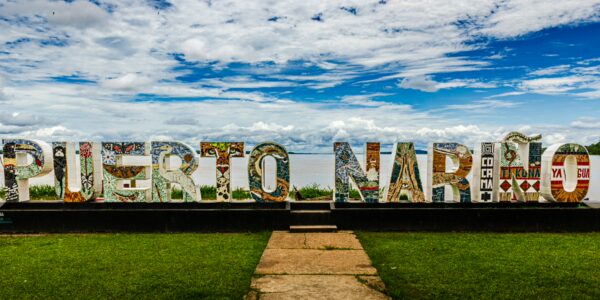
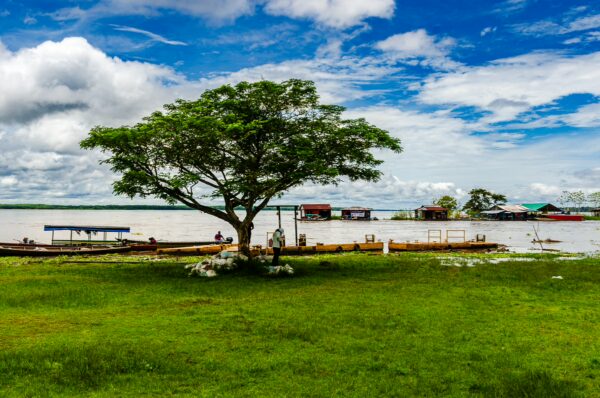
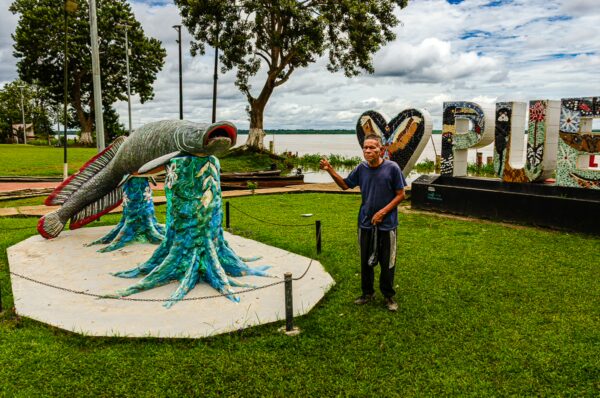
The central waterfront was the busiest part of Puerto Nariño, with both tourists and locals gathering near the docks. Toward the eastern end sits a small park with the town’s name sign and a statue of an arapaima, the giant Amazonian fish. Near the port, there are several cheap open-air food stalls. We grabbed lunch at one of them, followed by an ice cream from the village shop, then walked back to the dock in time for the boat back to Leticia.
Accommodation & Tours in Puerto Nariño
Explore stays on the map below, or check out my full guide to accommodation in Puerto Nariño.
Stay22 is a handy tool that lets you search for and compare stays and experiences across multiple platforms on the same neat, interactive map. Hover over the listings to see the details. Click on the top-right settings icon to adjust your preferences; switch between hotels, experiences, or restaurants; and activate clever map overlays displaying information like transit lines or concentrations of sights. Click on the Show List button for the listings to appear in a list format. Booking via this map, I will be earning a small cut of the platform's profit without you being charged any extra penny. You will be thus greatly helping me to maintain and keep enriching this website. Thanks!
Video
Photos
View (and feel free to use) all my photographs from Puerto Nariño.
More from the Colombian Amazon
- Piranha Lake & Gamboa Reserve: A Two-Day Amazon Tour from Leticia
- What to Do in Leticia – Our 5 Days in the Colombian Amazon
- Where to Stay in Puerto Nariño, Colombia: Best Hotels & Lodges
- Where to Stay in Leticia, Colombia: Best Areas & Lodges
- Leticia, Amazonas, Colombia (2026) – Photos
- Gamboa Nature Reserve, Loreto, Peru (2026) – Photos
- Santa Rosa, Loreto, Peru (2026) – Photos
- Puerto Nariño, Amazonas, Colombia (2026) – Photos